

Pragmatic instead of perfect – 5 steps to successful digitalization

Many companies today face the same challenge: The pressure to digitize is high, yet SAP projects in logistics quickly appear complex and risky. The initial phase is crucial in determining whether a digitization project will generate real added value. In his article, our Associate Consultant Samir Rahman demonstrates what a clear, pragmatic roadmap looks like – and why small, well-planned steps often achieve more than a grand, sweeping undertaking.
„"We need to digitize, but how do we even begin?"“
I hear this question in almost every initial consultation. And I can certainly understand why: SAP projects in logistics quickly seem too big, too complex, too risky. But what I've seen over the years is that success is determined right at the beginning.
If goals, roles, processes, and data are unclear, digitalization quickly turns into just another IT project with little real benefit. My advice is therefore: a clear, pragmatic roadmap – better to start pragmatically than to plan perfectly.
Below, I will share my proven process based on many real project experiences and show you what you should pay attention to from the beginning.
1. Current state analysis & potential check – Where do you stand today? What obstacles exist?
Before investing in technology, one needs clarity about the status quo.
- Which processes are running smoothly, and which are experiencing problems?
- What data is available, and what is its quality?
- Where are the interface problems, legacy systems, and isolated solutions?
- What knowledge does each member of your team bring – and who is still missing?
This analysis offers two major advantages: Firstly, it minimizes surprises in the project. Secondly, it creates a sound basis for identifying potential and priorities – instead of relying on gut feelings.
2. Define goals & identify quick wins – make successes visible before the big stage arrives.
Many projects get bogged down in long-term goals and lose motivation. My approach: Set realistic, measurable goals and identify quick wins.
Examples:
- A section of the warehouse process that runs faster through automation.
- Clear data quality in a critical subprocess
- Improved transparency of part of the logistics route
- An MVP to test the system
Such small successes foster motivation, confidence, and learning potential. They demonstrate early on that digitalization is not an abstract project, but rather a value-creating change.
3. Standardize and prioritize processes – SAP loves clear processes; chaos is its enemy.
A common mistake I see is trying to adopt existing complexity completely. But if processes are unclear, redundant, or contradictory, the move to SAP becomes too difficult.
Procedure:
- Visualizing processes to a limited extent
- Identifying interfaces and handovers
- Merge and standardize process variants
- Transform only the prioritized sub-areas first.
This doesn't mean a "one-size-fits-all" solution – but it does mean avoiding uncontrolled growth within the system and creating a robust foundation. SAP implementations (especially SAP EWM or S/4HANA logistics components) benefit enormously from structured, stable processes.
4. Selecting the right technology – Right focus, future-proof foundation
Once processes and priorities are clarified, the technical part comes next: Which solution is suitable – SAP EWM (embedded or decentralized), in private or public cloud? Which modules, add-ons, or integrations do I need?
Important aspects:
- Future-proof and update-proof
- Good integration with existing systems
- Use SAP standard features wherever possible; add extensions only where necessary.
- Filtering according to critical requirements (e.g. high-bay warehouse, multi-level, automation)
Especially in the area of warehouse management, best practices apply: use standard processes, address data cleansing early, and plan validation steps.
5. Select and implement a pilot area – test, learn, scale
First, implement your solution in a limited area – ideally in a process that is important but remains controllable.
Advantages:
- They gain practical experience before rolling it out on a large scale.
- They discover unexpected challenges early on.
- They gain acceptance and credibility within the team.
- They optimize before investing in more complex areas.
Important: Define clear metrics (e.g., throughput time, error rate, resource utilization). Learn continuously, adjust – and then scale to other areas.
Why this approach works
1. Early clarity reduces risks
2. Motivation through quick wins
3. Structured processes create stability
4. Technical decisions are made on a sound basis.
5. A pilot area provides concrete findings – no „flying blind“
Your entry point: not by chance, but by design.
Together we will look at your starting situation and I will show you how your entry can look realistic, tangible and successful.
More blog posts
Implementing SAP: Why the partner is more important than the software
Why software is only half the battle. Imagine this: You've spent months evaluating, comparing, and negotiating. You've decided on SAP. The budget is in place.
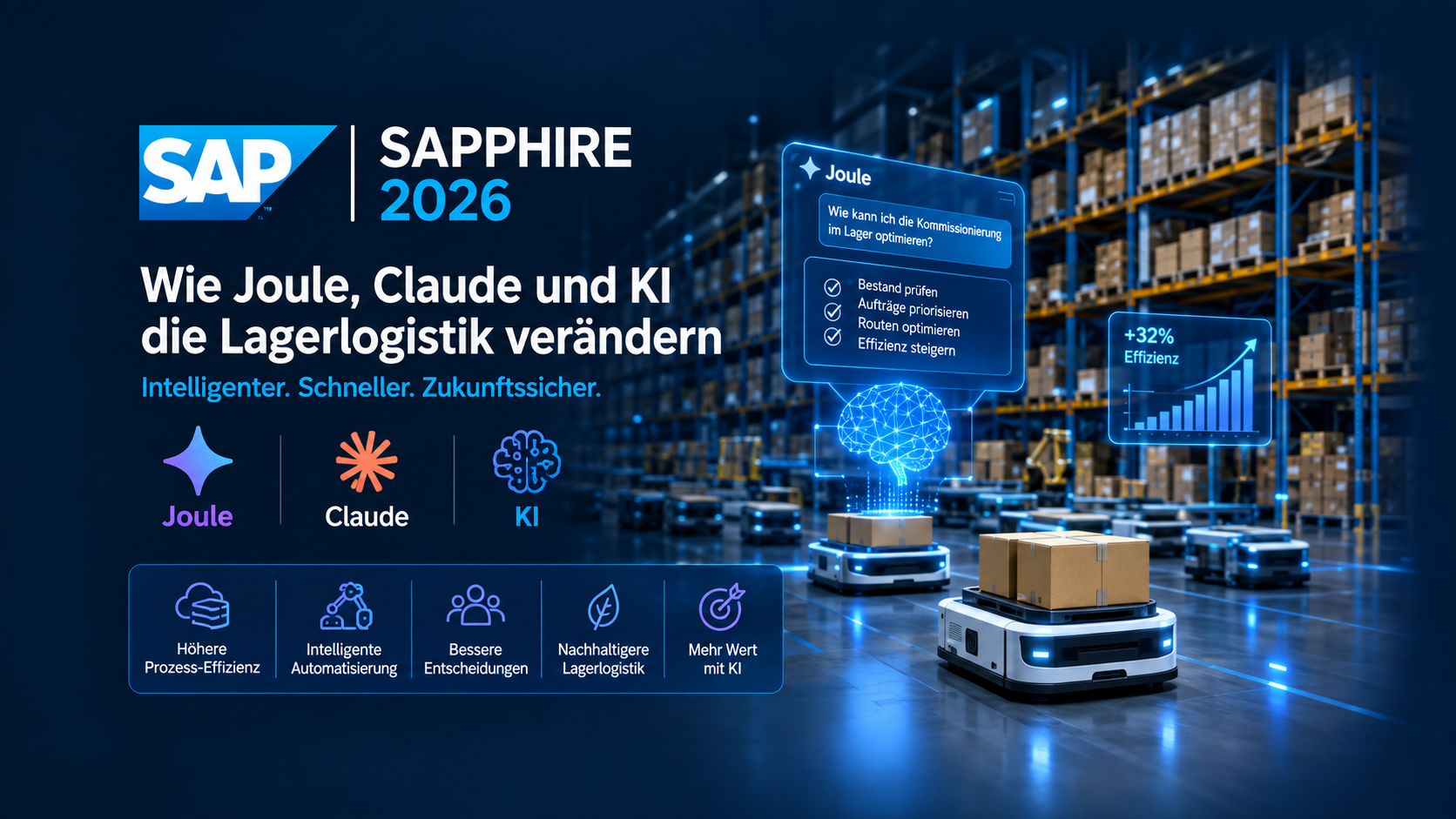
SAP Sapphire 2026: Joule, Claude & AI are changing warehouse logistics
SAP Sapphire 2026 was all about artificial intelligence and the "Autonomous Enterprise." For logistics and EWM managers, this presents a key challenge: