

SAP LGM: The strategic gap is closed – efficient growth
Expectations for logistics are constantly rising. Given volatile markets and the pressure for automation, the crucial IT question is: How do we manage growth without complexity and costs exploding?
Until now, many SAP users faced a dilemma:
They could either use the streamlined but functionally limited SAP Stock Room Management (SRM) – or opt directly for SAP Extended Warehouse Management (EWM), which, while powerful, was often oversized for smaller or decentralized warehouses. The result: fragmented process landscapes, redundant solutions, and expensive integration efforts.
With the introduction of SAP Logistics Management (LGM) in October 2025, SAP is closing precisely this strategic gap. LGM is a cloud-based logistics module specifically designed for organizations with multiple, moderately complex warehouse locations – and enables significantly leaner, more standardized, and more intuitive handling of logistics processes.
The historical challenge: The dilemma of system choice
In the past, SAP customers often faced a difficult choice of system:
Either the straightforward SAP Stock Room Management (SRM) was available, or the highly functional SAP Extended Warehouse Management (EWM). Many companies tried to standardize their global locations with EWM and SAP Transportation Management (TM).
However, for warehouses of lower complexity, SAP EWM often proved to be oversized: the implementation time was long, the configuration effort complex, and the training requirements high.
The result was an inefficient and fragmented IT landscape: Since the use of EWM was not cost-effective for smaller locations, companies stuck with limited SRM functions or resorted to isolated solutions. This prevented end-to-end transparency and process integration.
SAP LGM closes the gap
This situation changes with SAP LGM. The module was introduced at SAP Connect in Las Vegas in October 2025 and is designed for SAP S/4HANA customers with multiple, small to medium-sized sites that exhibit moderate complexity.
While complex distribution centers will continue to rely on the performance of EWM and TM, SAP LGM offers a lightweight, cloud-native alternative. Technologically, LGM is built on the SAP Business Technology Platform (BTP) and is continuously developed as a Software-as-a-Service (SaaS) solution. General availability is planned for the first quarter of 2026.
Mobile flexibility: Intuitive user experience for the warehouse
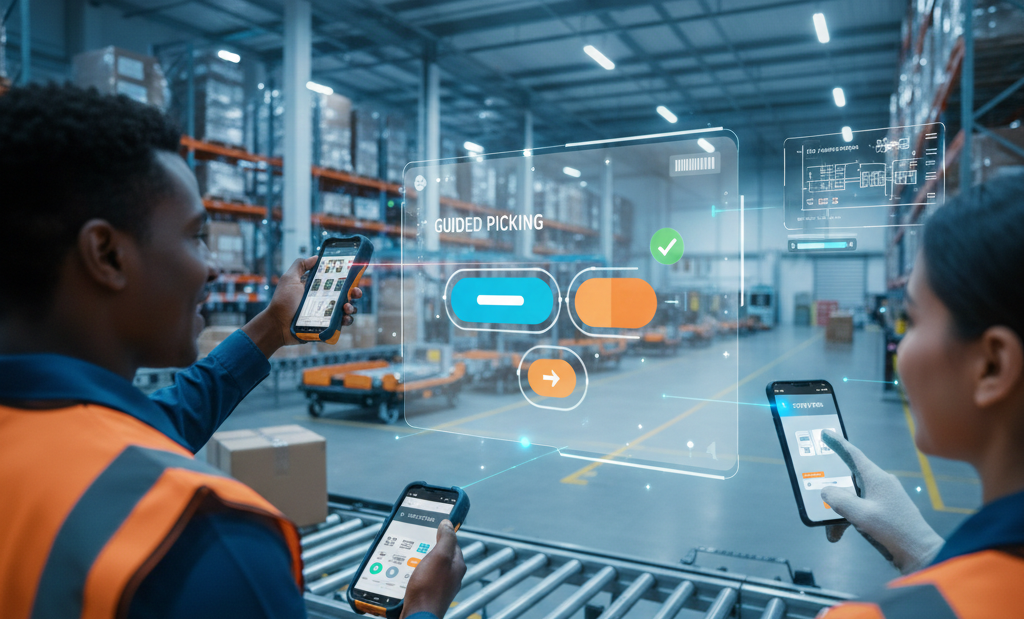
A key feature of SAP LGM is its native support for mobile processes, where user experience (UX) is paramount. The app was consistently developed to be intuitive and maximize acceptance among warehouse staff.
The accompanying mobile app (for Android and iOS) allows your employees to handle warehouse tasks paperlessly and in real time – directly from their mobile data entry device or smartphone. This covers all core processes from goods receipt and order picking to relocation.
The design of the app shows how important SAP considers the user experience:
Minimal training required: The system guides the user step by step through the tasks, so that new employees can quickly and safely take on tasks – true to the motto „Guided Picking“.
Ergonomics and clarity: With large, clear buttons and a simplified display, the app is ideally designed for use in warehouse environments, even with gloves.
Increased precision: Instead of manual input, barcode scanning is used. This drastically reduces input errors and ensures high data quality.
Real-time feedback: The employee receives immediate feedback on the status of their task.
This UX-optimized solution not only increases operational efficiency, but also ensures higher employee satisfaction and a faster time-to-productivity.
Positioning within the SAP portfolio
SAP SRM
SRM encompasses the basic warehouse management functions that are integrated into S/4HANA and can be used without an additional license. This is the most cost-effective option for very simple processes (e.g., inventory management, basic putaway/removal). However, SRM quickly reaches its limits as soon as more complex requirements (e.g., automation, wave planning, detailed packaging logic) come into play.
SAP EWM
EWM is the comprehensive solution for highly complex logistics scenarios. It covers the full range of functions, from replenishment control to the integration of highly automated technology via material flow control (MFS). EWM is the strategic choice for companies with global structures and a need for maximum functionality, even if this involves a higher implementation effort.
SAP LGM
LGM deliberately positions itself as an alternative for warehouses of low to medium complexity. It combines fundamental warehouse management and transport management functions in a single platform. The focus is on core processes such as goods receipt, order picking, packing, and goods issue, as well as the direct dispatching of freight. Features include integration with conveyor technology and hazardous materials handling.
Conclusion and Outlook
SAP Logistics Management undoubtedly addresses a clear and urgent need: It offers SAP customers a modern, integrated logistics platform that is significantly easier and faster to deploy than a full-fledged SAP EWM.
However, SAP LGM is currently still in its early stages and requires critical evaluation. SAP has already announced plans to rapidly expand its functionality and continuously optimize the module based on feedback from initial test customers. LGM is clearly positioned as the future standard for small and medium-sized warehouses and is expected to completely replace Stock Room Management once it has matured.
Conclusion: LGM is a promising component that closes the strategic gap. Companies should closely monitor the development of this module and consult the official roadmap to assess its long-term potential for their own IT strategy.

Max Fröhlich, SAP Consultant
Contact & Exchange
A little about me: I'm Max Fröhlich, an SAP EWM consultant. I'm currently focusing intensively on Logistics Management and I particularly appreciate that SAP is now placing such a strong emphasis on user-friendliness.
How do you assess its potential? Feel free to share your thoughts in the comments – I look forward to discussing it.
Leave a Reply