
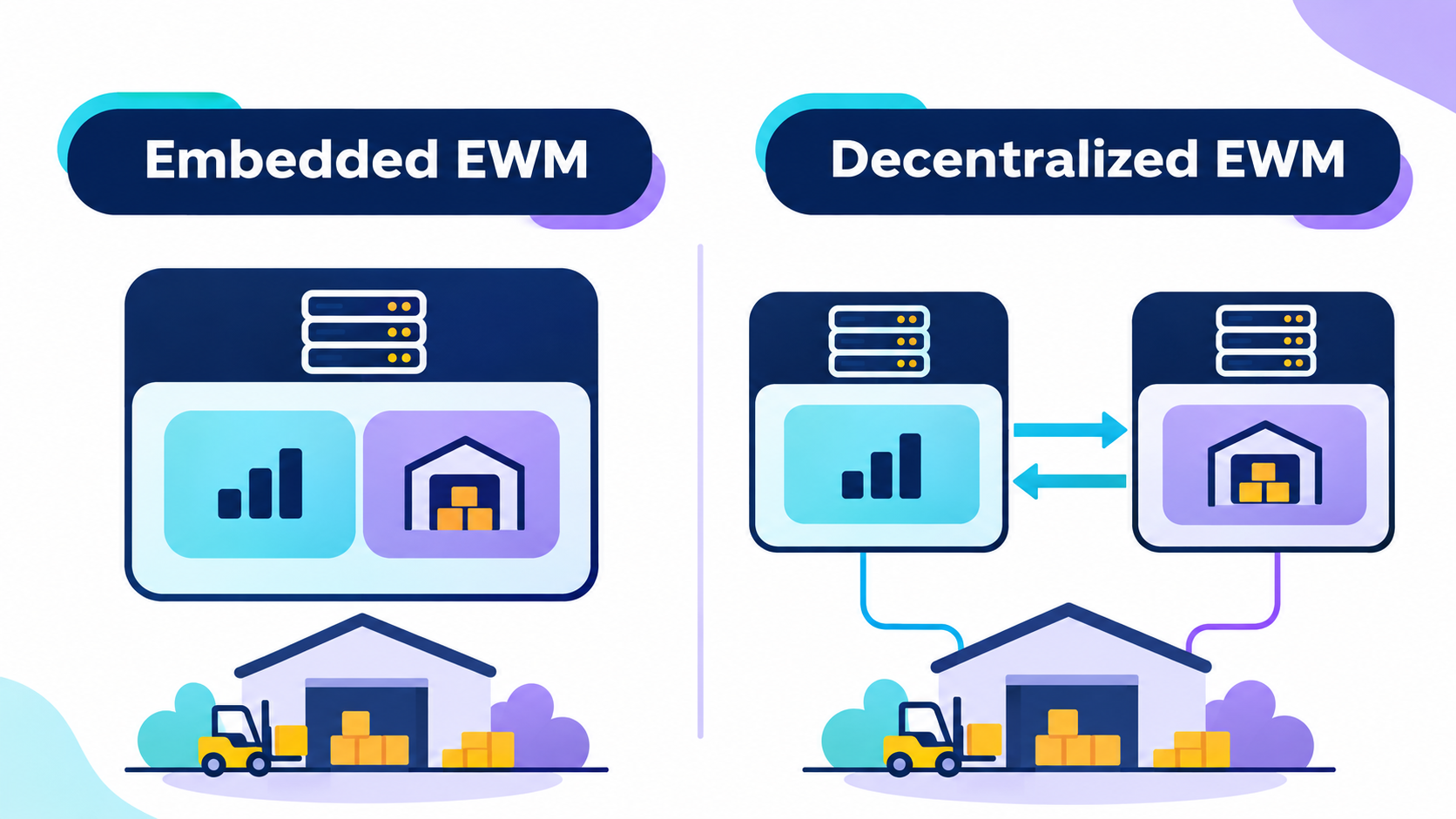
Decentralized EWM vs. Embedded EWM – what decision-makers need to know in 2027
The choice between embedded EWM and decentralized EWM is not simply a system question. It impacts processes, integrations, availability, automation, and the ongoing operation of a warehouse for many years. Therefore, for SAP and logistics managers, the key question is: Which architecture best suits their business processes, desired operating model, and future development?
Both options are based on SAP Extended Warehouse Management. The key difference lies in where EWM is operated and how closely it is integrated with the enterprise management system. This article neutrally assesses the options and highlights the criteria that will be particularly important when making a decision in 2027.
What does Embedded EWM mean?
With embedded EWM, warehouse management runs in the same SAP S/4HANA system as the relevant ERP processes. EWM is therefore an integral part of the central system landscape. Master data and business processes are located closer together, allowing many processes to function without an additional system boundary.
This simplifies integration, especially when a company wants to closely link its warehouse processes with procurement, production, sales, and inventory management. SAP describes scenarios for Embedded EWM, including synchronous goods movements between MM-IM and EWM. This allows inventory levels in specific production processes to be reconciled immediately.
The proximity to the S/4HANA core typically reduces integration and operational effort. At the same time, ERP and EWM share central maintenance windows, system resources, and availability concepts. This is efficient for many companies but must be considered in operational planning.
What is Decentralized EWM?
With Decentralized EWM, EWM runs in its own SAP S/4HANA instance, separate from the central enterprise management system. The decentralized system handles the warehouse processes and exchanges relevant data with the leading ERP or S/4HANA system.
Communication takes place via defined interfaces. In SAP scenarios, deliveries are distributed and feedback is transmitted to the leading system, among other things. For certain communication channels, asynchronous methods such as qRFC are used, which serialize messages and thus support orderly processing.
The additional layer increases the complexity of the system landscape. However, it can enable an independent operating and maintenance concept. Especially in large, highly automated, or 24/7 warehouses, this greater decoupling can be a relevant criterion. However, it is not an automatic guarantee that Decentralized EWM is always faster or more reliable.
Embedded and Decentralized EWM in direct comparison
| criterion | Embedded EWM | Decentralized EWM |
|---|---|---|
| System architecture | EWM in the same S/4HANA system | Dedicated S/4HANA instance for EWM |
| integration | Many processes within a system landscape | Additional ERP-EWM interfaces |
| Master data | Closer to the common database | Distribution and synchronization required |
| Operation | Joint administration and maintenance planning | Independent operational and release planning possible |
| Availability | Dependencies within the shared system | Stronger technical decoupling, but more components |
| Cost | Often lower infrastructure and integration costs | Additional licenses, infrastructure and operating costs |
| Scaling | Scaling in the overall S/4HANA context | Own capacity planning for the warehouse |
Integration: fewer interfaces or more decoupling?
Embedded EWM demonstrates its strengths when ERP and warehouse systems are closely integrated. Fewer cross-system transfers can increase transparency and reduce potential errors. This is especially true for companies with a central S/4HANA system and a manageable warehouse landscape.
Decentralized EWM is advantageous when a warehouse is to be operated independently, either technically or organizationally. This can be relevant with multiple ERP systems, regional warehouse platforms, heterogeneous system landscapes, or a phased transformation. However, the benefits only materialize if monitoring, master data distribution, error handling, and responsibilities are properly defined.
Performance and scalability
Performance does not depend solely on the deployment model. Crucial factors include data volume, warehouse layout, process design, parallelization, degree of automation, interface load, and hardware sizing.
Embedded EWM can operate efficiently due to short communication paths within the system. At the same time, ERP and warehouse processes compete for resources. Therefore, with very high booking volumes or demanding automation scenarios, it is essential to examine how peak loads affect both areas.
Decentralized EWM can consolidate warehouse processes in a dedicated instance and allocate capacities more effectively to the warehouse. However, this comes at the cost of additional communication channels. A poorly designed interface or a lack of monitoring can negate these advantages. Therefore, sound decisions should be based on measurements, process simulations, and realistic peak scenarios.
Availability and 24/7 operation
A decentralized EWM system can reduce the warehouse's dependence on centralized ERP maintenance if the operational concept explicitly allows for this. This does not automatically mean that a warehouse can continue operating completely independently in the event of every disruption. Which processes continue depends on the integration design, buffer mechanisms, automation, and restart concepts.
For embedded EWM, shared maintenance windows, high availability, backup, recovery, and disaster recovery processes should be planned with particular care. For both variants, availability is an architectural and operational performance characteristic, not a property that simply follows from the name "embedded" or "decentralized.".
What role does SAP MFS play?
SAP MFS connects EWM with automated warehouse technology components such as conveyor systems, stacker cranes, and warehouse control units. Both embedded and decentralized EWM can be suitable for automation scenarios. The question, therefore, is not whether MFS fundamentally only works with one variant, but rather how well the specific process and operational concept fits the architecture.
When making a decision, response times, telegram volume, restart time, buffering, monitoring, testability, and the boundaries of responsibility between EWM, MFS, and the plant control system should be considered. An automated warehouse alone is not a sufficient reason for a decentralized installation.
Costs: don't just compare licenses
Embedded EWM often offers advantages in terms of infrastructure, system maintenance, and interface operation. Decentralized EWM entails additional overhead for instances, data distribution, monitoring, security, release planning, and support. However, advantages can arise if decoupling reduces operational risks or enables separate scaling.
For a reliable TCO analysis, at least the following items must be included: software and infrastructure, implementation, interfaces, operation, monitoring, readiness, upgrades, testing, downtime costs, and the required internal expertise. An architecture with lower initial costs is not automatically cheaper over its entire lifecycle.
Typical use cases
- More likely embedded: a central S/4HANA system, tightly integrated production or sales processes, several normal warehouses and the leanest possible operating model.
- Rather decentralized: a highly automated distribution center, very high volumes, several leading ERP systems, or the desire for an independent warehouse operation.
- Check individually: 3PL scenarios, international warehouse landscapes, migration phases and locations with special availability requirements.
Decision criteria for 2027
- Process fit: What functions, storage types, production references and quality processes are needed?
- System landscape: Is there a leading S/4HANA system or multiple ERP contexts?
- Volume and peak: How many warehouse orders and telegrams are generated during peak times?
- Availability: Which processes must continue during central maintenance or malfunctions?
- Operating model: Who is responsible for infrastructure, interfaces, monitoring and 24/7 support?
- Life cycle: How are releases, tests, enhancements, and subsequent migrations organized?
- TCO: What costs will arise over five to ten years – not just within the project itself?
Conclusion
Embedded EWM and Decentralized EWM are not a simple good or bad choice. Embedded EWM is often a good fit for companies that prioritize integrated processes and a manageable system landscape. Decentralized EWM can offer advantages when a warehouse needs to operate in a particularly independent, highly automated, or cross-system manner.
In practice, a robust pilot project with realistic peak loads is recommended before making an architectural decision. This should measure not only dialogue times, but also warehouse order creation, RF communication, automation telegrams, monitoring, and restart times. Equally important is a shared target state for master data, authorizations, and error handling. A technically robust scenario may still be organizationally unsuitable if operations teams, service providers, or site managers cannot sustainably manage the additional system separation. Therefore, the decision should be documented jointly with the relevant department, SAP architecture, infrastructure, automation, and operations teams.
The best decision results from a structured comparison of processes, volume, availability, integration, and operating costs. Noor Vision helps companies to objectively evaluate SAP EWM architectures and determine the appropriate target architecture for their own warehouse logistics.
Sources and further information

My name is Max Fröhlich, and I work with SAP EWM at Noor Vision. I'm particularly interested in how system architecture, warehouse processes, and automation work together effectively. In my articles, I aim to explain technical concepts in an easy-to-understand way and show what's important for implementation in everyday warehouse operations.